Could Smarter Packaging Protect Children’s Electric Scooters During International Shipping?
A children’s electric scooter must arrive in a condition that matches the approved product sample. During international transportation, however, vibration, repeated handling, pressure from stacked cartons, and movement inside the package can affect the frame, finish, accessories, or electrical components. For overseas importers, these issues may lead to additional inspection work, delayed distribution, and unnecessary after-sales costs. Packaging should therefore be considered part of product development, with protection, storage efficiency, and packing consistency planned before bulk orders are prepared.
Identify Vulnerable Areas Before Packing
Different scooter components face different transportation risks. Exposed frame edges may develop scratches, plastic covers can be marked by contact, and loosely packed accessories may move against the main body. A folded handlebar or removable component can also create pressure points if it is not secured properly.
Manufacturers should review the scooter’s shape and component arrangement before selecting protective materials. Foam inserts, cardboard dividers, protective sleeves, and other suitable packing materials can help separate vulnerable surfaces. The goal is not simply to add more packaging, but to place protection where movement or contact is most likely to cause damage.
Secure Accessories and Small Components
A scooter package may contain a charger, fasteners, assembly tools, reflectors, or other accessories depending on the model. If these items are packed loosely, they can shift during transportation, become difficult to locate, or scratch nearby surfaces.
A defined accessory layout helps prevent these problems. Manufacturers can use separate compartments or secured inner bags to keep small components organized. Before sealing each carton, packing staff should verify the accessory list against the approved product configuration.
For buyers managing several models, clear identification is particularly important. Similar-looking chargers or hardware sets should not be mixed between versions with different specifications.
Protect Electrical Components From Handling Damage
Electrical parts require careful consideration during packaging. The battery, charger, connectors, and wiring should be protected according to their design and applicable transportation requirements. Packaging must not place excessive pressure on sensitive components or allow loose parts to damage cables and connection points.
Manufacturers should also confirm that the battery and charger documentation, labels, and packing arrangements match the requirements for the intended shipping route. Any applicable battery transportation documentation should be prepared before dispatch rather than left until the shipment is ready to leave the facility.
Test the Complete Package
Packaging decisions should be evaluated using the actual packed product, not only the empty carton. The finished package can be checked for movement, closure strength, and protection around vulnerable areas. Appropriate handling or distribution tests can help reveal weaknesses before larger production quantities are shipped.
For Kids Electric Scooter Manufacturers, packaging verification should follow a repeatable procedure. If a test reveals damage or excessive movement, the protective layout can be adjusted and checked again. Recording the approved packing method also helps ensure that later batches follow the same standard.
Balance Protection With Shipping Efficiency
Oversized cartons can occupy unnecessary warehouse and shipping space, while packaging that is too compact may leave insufficient room for protection. Manufacturers should consider the scooter’s folded dimensions, accessory placement, protective materials, and carton strength together.
A well-planned package can support more predictable warehouse handling without sacrificing product protection. Buyers should confirm carton dimensions and gross weight during sample approval, particularly when shipment planning depends on standardized packaging information.
Maintain Consistency Across Bulk Orders
An approved packaging specification should identify the carton type, internal protection, accessory arrangement, labels, and sealing method. Packing instructions should be available to production staff, and changes should be documented before implementation.
Final inspections can verify that the scooter is properly protected, accessories are complete, and product labels match the order requirements. These checks help reduce avoidable differences between the first shipment and repeat orders.
Make Delivery Quality Part of Product Quality
For overseas buyers, a successful order depends on more than the scooter’s riding performance. Packaging must protect the product, keep accessories organized, and support efficient handling from factory dispatch to warehouse receipt. By treating packaging as an integral part of manufacturing, suppliers can help importers reduce preventable shipping problems and receive products that are ready for inspection, distribution, and retail preparation.
Can Better Product Planning Make Kids’ Electric Scooters Easier to Manufacture?
Developing an electric scooter for children involves more than combining a motor, battery, wheels, and frame. Each component affects the product’s handling, appearance, assembly process, and overall reliability. For overseas buyers, a well-planned design can make the difference between a product that looks attractive in a sample and one that performs consistently in bulk orders. Manufacturers need to consider the needs of young riders alongside production feasibility, component compatibility, and the expectations of distributors serving different markets.
Design Around Real Riding Needs
Children need a scooter that suits their physical proportions and developing coordination. Handlebar height, deck dimensions, grip design, and overall weight can all affect how comfortably a rider handles the product. If these elements are considered separately, the finished scooter may be difficult to control or inconvenient to transport.
During product development, manufacturers should evaluate how the main dimensions work together. A compact frame may support easier storage, while an appropriately designed deck can provide practical foot placement. The final configuration should reflect the intended age group, rider weight range, and operating conditions rather than relying on appearance alone.
Balance Appearance With Structural Requirements
Color, surface finish, and styling influence how a scooter fits a retail product range. However, decorative choices should not compromise the function of structural components. The frame, steering assembly, wheel supports, and fasteners need to work together under the intended operating conditions.
Manufacturers can assess material selection and component placement during prototype development. Potential interference between parts should be identified before production tooling and assembly procedures are finalized. This approach can reduce avoidable revisions and help maintain a consistent appearance across different color or configuration options.
Make Component Compatibility a Priority
An electric scooter contains mechanical and electrical systems that must function as a coordinated unit. Motor output, controller settings, battery capacity, wiring arrangements, throttle response, and braking configuration should be reviewed together.
For Kids Electric Scooter Manufacturers, component compatibility is especially important when developing multiple models for different price points or age groups. A change in one component may affect weight, performance, installation space, or operating behavior elsewhere in the product.
Before confirming a design, manufacturers should check:
Whether electrical connections match the selected components
Whether wiring is properly routed and protected
Whether the braking and control systems function as intended
Whether replacement components can be identified by model and specification
These checks help make assembly and subsequent maintenance more manageable.
Establish Repeatable Assembly Procedures
A successful prototype does not automatically guarantee consistent mass production. Differences in fastening, wiring installation, component positioning, and adjustment can affect the finished product if assembly instructions are unclear.
Manufacturers should define key assembly steps and inspection points before increasing production volume. Functional checks can cover throttle operation, braking response, steering movement, electrical connections, and charging performance. Recording inspection results also helps production teams identify recurring defects and improve process control.
For buyers, a clear quality-control process provides a more useful basis for supplier evaluation than a sample inspection alone.
Plan Customization Before Bulk Orders
Overseas distributors may request different colors, packaging designs, labels, or accessory combinations. These options can help a product fit a particular market, but they also introduce additional requirements for material preparation, inventory management, and order tracking.
A manufacturer should confirm the approved specifications for each version before production begins. Samples, color references, packaging artwork, and component lists should be reviewed together to reduce the risk of mixing configurations. Changes made after approval should be documented so that purchasing and production teams work from the same information.
Prepare the Product for Storage and Delivery
Packaging is part of the product plan, not simply the final step before shipment. The scooter, charger, instructions, and accessories need to fit securely within the selected carton. Suitable internal protection can help limit movement during transportation, while clear labeling supports warehouse identification.
Manufacturers should also confirm carton dimensions and packing arrangements early enough to coordinate production and shipping requirements. For buyers placing repeat orders, maintaining an approved packaging specification can make replenishment more predictable.
Turn Product Requirements Into Manufacturing Value
Choosing a suitable electric scooter means looking beyond individual specifications. For buyers comparing Kids Electric Scooter Manufacturers, the most useful discussions cover design suitability, component coordination, assembly controls, customization, and packaging as one connected process. When these details are established before mass production, manufacturers can better manage product consistency, while overseas buyers gain a clearer basis for evaluating samples and planning future orders.
Why Does Service-Friendly Design Matter for Children’s Electric Scooters?
A children’s electric scooter may look simple from the outside, but its long-term usability depends on how well its components are designed, assembled, and maintained. For distributors and importers, after-sales issues can affect customer satisfaction, replacement costs, and the workload of service teams. Manufacturers therefore need to consider what happens after a scooter leaves the production line. Practical maintenance access, clearly identified components, and straightforward inspection procedures can make a product easier to support throughout its service life.
Make Routine Inspection Easier
Scooters used regularly may experience loose fasteners, worn tires, damaged grips, or changes in braking performance. These conditions do not necessarily indicate a product defect, but they show why routine inspection should be considered during product development.
Manufacturers can improve serviceability by making important inspection points accessible without requiring unnecessary disassembly. Clear assembly drawings and maintenance instructions can also help service personnel identify the relevant components before beginning work. For buyers managing multiple product models, consistent component placement can simplify staff training and reduce confusion during routine checks.
Keep Electrical Components Well Organized
The motor, controller, battery, wiring, and throttle form an interconnected electrical system. Poorly planned wire routing can make inspection difficult and increase the risk of wires being pinched or exposed to repeated movement.
During development, manufacturers should consider how cables pass through the frame and connect to individual components. Connections need to be secure and appropriately protected for the scooter’s intended operating conditions. The design should also allow qualified service personnel to inspect relevant connections without disturbing unrelated parts unnecessarily.
Electrical maintenance instructions should clearly explain which checks are permitted and when professional service is required. Battery and charging components deserve particular attention because incorrect handling can create safety risks.
Consider Wear Parts During Product Development
Some components naturally experience more contact and movement than others. Tires, grips, brake parts, and selected fasteners may require inspection or replacement depending on usage and the product design.
For Kids Electric Scooter Manufacturers, identifying these components early can improve spare-parts planning. A manufacturer can maintain clear part numbers, model references, and replacement specifications so buyers know which items match each version.
This becomes especially useful for distributors handling several scooter models. Accurate identification helps reduce ordering errors and makes it easier to keep commonly required parts available without building an unnecessarily large inventory.
Choose Materials With Cleaning in Mind
Scooters are used in different environments, and dust, dirt, and moisture can affect their appearance and condition. Surface finishes and material choices should therefore support practical cleaning while remaining suitable for the intended application.
Manufacturers should consider whether exposed surfaces are easy to wipe down and whether gaps around joints are likely to collect debris. Cleaning instructions should distinguish between external surfaces and electrical areas that must not be exposed to water. Simple, clear guidance can help users avoid maintenance practices that may damage components.
Reduce Unnecessary Disassembly
A product that requires extensive disassembly for a basic inspection can increase service time and complicate repairs. During prototype evaluation, manufacturers should review the accessibility of fasteners, covers, connectors, and replaceable parts.
Service-friendly construction does not mean making every component removable by the end user. For children’s electric scooters, structural integrity and electrical safety remain essential. Instead, the goal is to provide appropriate access for trained personnel while keeping critical assemblies secure during normal use.
Support After-Sales Teams With Clear Documentation
Product documentation should identify the scooter model, key specifications, compatible accessories, and relevant maintenance procedures. Exploded diagrams or clearly labeled component lists can help service teams communicate more accurately with suppliers and customers.
Manufacturers should also maintain consistent documentation when specifications change. If a component is revised between production batches, the related part number and compatibility information should be updated accordingly. This helps prevent confusion when buyers request replacements for products purchased at different times.
Build Long-Term Value Into the Design
For overseas buyers, serviceability is an important part of product planning rather than an issue to address only after complaints arise. A well-designed children’s electric scooter combines appropriate riding characteristics with accessible inspection points, identifiable spare parts, and clear maintenance guidance. By considering these details during development, manufacturers can make after-sales support easier to organize and help distributors manage their product ranges with greater confidence.
What Should Buyers Prioritize When Developing Electric Scooters for Children?
Children's electric scooters combine mobility, recreational use, and product design in a category where safety and usability need to work together. For overseas distributors and retailers, selecting a suitable model involves more than comparing appearance or advertised speed. Buyers also need to consider the intended age group, riding environment, control layout, battery protection, and product testing requirements. For manufacturers, the challenge is to translate these expectations into a design that is practical to use, consistent to produce, and appropriate for the target market.
Match the Design to the Intended Age Group
Children of different ages may have different levels of coordination, strength, and experience with powered riding products. A scooter intended for younger riders should not simply be a smaller version of an adult model. Handlebar height, deck dimensions, overall weight, acceleration behavior, and braking access all deserve careful consideration.
When evaluating products from Kids Electric Scooter Manufacturers, buyers should confirm the manufacturer's recommended age range and the specific limitations of each model. Product selection should reflect the intended user's physical capabilities and the riding conditions described in the instructions.
Clear age guidance also helps distributors organize their product ranges and communicate appropriate expectations to customers.
Treat Speed Control as a Design Requirement
Motor output and maximum speed often attract attention during product development, but controlled acceleration and predictable braking are equally important. A scooter that responds too abruptly may be difficult for an inexperienced rider to manage.
Manufacturers should assess how the controller, motor, throttle, and braking system work together. Depending on the model, relevant design considerations may include a controlled starting response, suitable speed settings, and a braking arrangement appropriate to the scooter's intended use.
Buyers should request clear specifications for these functions and verify that the finished product matches the approved configuration. Safety-related claims should be supported by appropriate testing rather than appearance or marketing descriptions alone.
Evaluate Battery Protection and Charging Design
Battery selection affects product weight, operating time, charging arrangements, and overall system design. For children's electric scooters, battery protection also deserves close attention because the product may be handled by inexperienced users.
Manufacturers should evaluate battery compatibility, electrical connections, charging control, enclosure protection, and the behavior of relevant protective circuits. The charging equipment must be compatible with the battery system, while user instructions should explain proper charging, storage, and inspection practices.
For procurement teams, confirming the battery specifications and applicable product safety requirements before placing a bulk order can help prevent avoidable redesigns and documentation gaps.
Check Structural Stability and Riding Comfort
A scooter's frame, deck, wheels, steering assembly, and folding components, where fitted, must work as an integrated structure. Loose connections, unsuitable component dimensions, or inadequate structural design may affect handling and service life.
During development, manufacturers should evaluate the product under conditions relevant to its intended use. Inspection can cover fastener security, steering movement, wheel installation, brake operation, and structural integrity according to the applicable test plan.
Deck dimensions and grip surfaces also influence how comfortably riders can position their feet. These details should be reviewed alongside the overall geometry instead of being treated as cosmetic features.
Build Quality Checks Into Every Production Stage
A successful sample does not automatically guarantee consistency across a large shipment. Component variation, assembly differences, and changes in electrical parts can affect finished products if production controls are insufficient.
A practical quality plan may include:
Incoming inspection of critical components
Verification of battery and charger compatibility
Checks of steering, braking, and throttle functions
Inspection of frame assembly and fasteners
Functional testing and final appearance checks
Confirmation of labels, instructions, and packaging
Manufacturers should establish inspection criteria for each model and retain relevant production records. This makes it easier to identify recurring defects and keep bulk orders aligned with approved samples.
Prepare Products for Different Market Requirements
Overseas buyers may need different colors, packaging, labels, accessories, or product configurations for their respective sales channels. However, customization should be reviewed carefully when it affects electrical systems, structural components, or safety-related functions.
Before production, buyers should confirm the target market, intended age group, required documentation, packaging specifications, and applicable regulatory obligations. Manufacturers can then assess whether the requested changes are compatible with the product design and production process.
Clear communication at this stage helps reduce misunderstandings during sample approval and supports more predictable repeat orders.
Choose a Manufacturing Partner With Clear Processes
Developing a children's electric scooter requires coordination between mechanical design, electrical integration, assembly, testing, and product documentation. Buyers should evaluate how a manufacturer manages these activities rather than relying solely on a product photograph or a short specification sheet.
For overseas procurement teams, clear technical communication, traceable quality checks, and consistent production standards provide a stronger foundation for long-term cooperation. When product design and manufacturing controls reflect the needs of young riders and their intended environments, businesses can make more informed sourcing decisions and build a product range around clearly defined requirements.
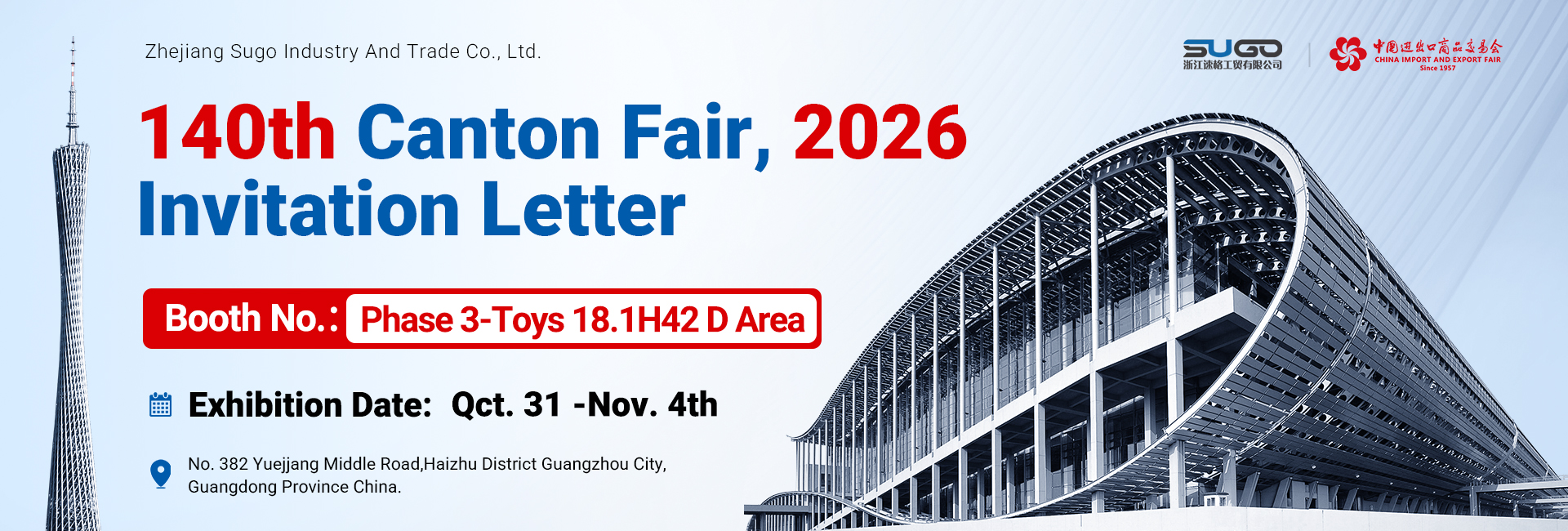
Sugo to Attend the 140th Canton Fair 2026 – Visit Our Booth
Zhejiang Sugo Industry And Trade Co., Ltd., a professional electric scooter manufacturer and factory in China, is pleased to announce our participation in the 140th Canton Fair 2026.
Founded in 2017 in Jinyun, Zhejiang Province, Sugo specializes in the manufacturing of electric scooters, kids' kick scooters and adult kick scooters. With convenient access to Yiwu and Ningbo Port, our location provides efficient logistics and competitive manufacturing advantages for international customers.
At the upcoming Canton Fair, we will showcase our latest scooter products and welcome importers, wholesalers, distributors, retailers and brand owners to visit our booth. It will be a great opportunity to learn more about our product range, manufacturing capabilities and potential OEM/ODM cooperation.
Exhibition Information
Event: 140th Canton Fair 2026
Phase: Phase 3 – Toys
Booth No.: 18.1H42, D Area
Date: October 31 – November 4, 2026
Venue: Canton Fair Complex, No. 382 Yuejiang Middle Road, Haizhu District, Guangzhou, Guangdong, China
With a 4,000-square-meter factory and a monthly production capacity of more than 15,000 units, Sugo is equipped to support stable bulk orders and long-term cooperation. We also hold ISO9001 quality management certification and BSCI social compliance certification, while our growing range of patented products reflects our continued focus on product innovation.
Whether you are looking for electric scooters for adults, kids' kick scooters, adult kick scooters or customized scooter solutions, we welcome you to meet our team at the Canton Fair and discuss your sourcing requirements.
Visit Sugo at Booth 18.1H42 in D Area during Phase 3. We look forward to meeting you in Guangzhou and exploring new business opportunities together!
Zhejiang Sugo Industry And Trade Co., Ltd.Electric Scooter Manufacturer & Factory in China
How Can Smarter Product Development Improve Children's Electric Scooters?
Developing a children's electric scooter involves balancing practical usability, manufacturing consistency, and long-term product support. A design that performs well during an initial demonstration may still present challenges when it enters mass production, particularly if components are difficult to assemble, replacement parts are inconsistent, or inspection procedures are unclear. For manufacturers serving overseas buyers, effective product development should therefore consider the complete product lifecycle, from early design decisions to final assembly and after-sales support.
Design Components to Work Together
An electric scooter consists of interconnected mechanical and electrical systems. The frame, steering assembly, wheels, motor, controller, battery, and braking components must be compatible with one another. A change to one part may affect the dimensions, performance, or installation requirements of another.
During development, manufacturers should review component interfaces before confirming the final design. This includes mounting positions, wiring routes, connector compatibility, fastener access, and the space available for electrical components.
For buyers comparing Kids Electric Scooter Manufacturers, asking how component compatibility is managed can provide useful insight into the supplier's development process. A coordinated design is easier to evaluate, assemble, and maintain than one in which individual components are considered separately.
Simplify Assembly Without Compromising Quality
Assembly efficiency depends partly on how easily workers can position, connect, and secure each component. Poor access to fasteners, unclear wiring arrangements, or inconsistent part dimensions can increase assembly difficulty and create opportunities for mistakes.
Manufacturers can address these issues by reviewing assembly sequences during the prototype stage. Practical improvements may include clearer component identification, more accessible fastening points, organized wiring paths, and standardized work instructions.
These measures should support consistent assembly rather than simply reduce the time spent on each unit. For children's electric scooters, critical connections and safety-related components still require appropriate verification before the product moves to the next production stage.
Maintain Control Over Electrical Connections
Electrical integration requires particular attention because the battery, controller, motor, throttle, and charging system must operate as a compatible unit. Incorrect connections, poorly secured wiring, or unsuitable component substitutions can lead to functional problems.
Manufacturers should establish clear wiring documentation and verify connections during assembly. Depending on the design, inspection may include connector seating, cable routing, insulation condition, and the operation of relevant electrical controls.
Changes to electrical components should be reviewed before implementation. Keeping approved specifications and component records helps prevent unintended differences between production batches and makes later troubleshooting more manageable.
Use Functional Testing to Find Problems Early
Final inspection should confirm more than whether the scooter looks complete. Functional testing helps determine whether key systems operate according to the approved design.
A product-specific test plan may cover:
Throttle response and motor operation
Brake function and steering movement
Battery charging and relevant electrical protections
Fastener security and assembly condition
Unusual noise or vibration during operation
Display, indicator, or lighting functions where fitted
The exact procedures should reflect the model's design and applicable requirements. Manufacturers should document results and investigate failures instead of relying only on a brief visual check.
Plan for Maintenance and Replacement Parts
Product support is easier to manage when commonly serviced components can be identified and supplied consistently. Depending on the scooter design, buyers may need replacement tires, brake components, chargers, grips, or electrical parts.
Manufacturers should establish part numbers, compatible model references, and clear replacement instructions. Service information should distinguish between routine checks that users can perform safely and repairs that require qualified personnel.
For overseas distributors, this information can help organize spare-parts inventory and respond to customer questions more efficiently. It also gives buyers a clearer understanding of how the product can be supported after delivery.
Keep Bulk Production Aligned With Approved Samples
A product approved during development should remain the reference for mass production. Changes in materials, component suppliers, assembly methods, or packaging can affect the finished product and should be reviewed before they are introduced.
Manufacturers can maintain consistency by documenting the approved configuration, defining inspection criteria, and checking production units against relevant specifications. Batch records also help identify when a problem occurs and which corrective measures may be needed.
For wholesale buyers, this process supports clearer acceptance standards and reduces uncertainty when placing repeat orders.
Build Long-Term Value Into Manufacturing Decisions
A well-developed children's electric scooter reflects coordinated engineering, controlled assembly, functional verification, and practical product support. Manufacturers that consider these elements together can identify design weaknesses earlier and establish more repeatable production procedures.
For overseas buyers, evaluating development methods and manufacturing controls alongside product specifications helps create a more complete basis for supplier selection. Consistent documentation and a clear approach to product support can also make ongoing procurement easier to manage as product ranges and customer requirements evolve.
Why Choose Electric Scooters for Urban Commuting?
With worsening urban traffic congestion and difficult parking, electric scooters have become the mainstream choice for short-distance travel. They are widely recognized for lightweight design, high flexibility and low cost, perfectly matching 3–10 km urban mobility scenarios.
The biggest advantage of electric scooters is portability. Foldable and lightweight bodies can be easily carried into elevators, subways and offices without dedicated parking spaces, perfectly solving the “last mile” travel problem. Compared with cars and traditional electric vehicles, electric scooters consume less energy and require almost no maintenance.
Modern electric scooters are equipped with smart displays, multi-speed adjustment, shock absorption systems and LED lights, ensuring safer and more comfortable riding day and night. They are faster and more labor-saving than walking and shared bikes, greatly improving travel efficiency.
As an eco-friendly travel tool with zero emissions, electric scooters conform to the green travel trend. They are ideal for commuting, shopping, campus travel and park sightseeing, bringing efficient and convenient mobility to modern urban life.
What Core Parameters Determine Electric Scooter Riding Experience?
Many buyers only focus on appearance and price when choosing an electric scooter, ignoring the key parameters that directly affect riding experience. A high-quality electric scooter depends on battery range, motor power, tire configuration, load capacity and braking system.
Battery performance determines real cruising range. Premium lithium batteries provide stable endurance and good low-temperature resistance, fully meeting daily short-distance travel needs. Powerful motors ensure smooth riding on slopes, speed bumps and uneven city roads without lag or insufficient power.
Tire design greatly affects comfort and safety. Large inflatable tires offer excellent shock absorption for complex urban roads, while solid tires are puncture-proof and maintenance-free for stable daily commuting. Dual braking systems shorten braking distance and effectively avoid risks in sudden road conditions.
Load capacity, foldable design and waterproof rating also improve practicality. Reliable electric scooters balance portability, stability and safety, perfectly suitable for student commuting, office worker travel and short-distance urban mobility.

 English
 русский
 Français
 Español
 Português
 Deutsch